







The Ultimate RC Airplane Buying Guide: How to Choose Your First (or Next) Plane
By Atlanta Hobby Expert Flight Staff • Updated September 2026 • 10 Min Read
🎯 Interactive Pilot Plane Matcher
Answer two quick questions about your flight experience and flying field to find the ideal aircraft:
Equipped with SAFE technology, panic recovery, pusher propeller protection, and self-leveling pitch/roll envelopes to guarantee a stress-free first flight.
Explore RC Airplanes at Atlanta Hobby ➔Chapter 1: Completion Levels Explained (RTF, BNF, PNP & ARF)
When browsing the Atlanta Hobby Airplane Collection, you will see specific acronyms in product titles. Here is what they mean so you know exactly what is included in the box:
✅ RTF (Ready-To-Fly)
The Absolute Best Choice for Complete Beginners. Everything you need to fly is inside one single box: the assembled airframe, electric brushless motor, ESC, flight receiver, rechargeable LiPo flight battery, charger, and a 2.4GHz handheld radio transmitter.
🔗 BNF / BNF Basic (Bind-N-Fly)
Ideal for Pilots Who Already Own a Transmitter. The airplane comes 100% built with servos, motor, ESC, and a Spektrum receiver with SAFE/AS3X pre-installed. All you do is "bind" it to your existing Spektrum radio transmitter and plug in your own flight pack battery.
🔌 PNP (Plug-N-Play)
For Pilots Using Any Brand of Radio Gear. The airframe comes equipped with all internal servos, brushless motor, and electronic speed controller (ESC), but does not include a receiver, transmitter, battery, or charger. You install your preferred receiver brand (Futaba, Spektrum, Radiomaster, FrSky).
🛠️ ARF & Kits (Almost-Ready-to-Fly)
For Traditional Builders & Customizers. Mostly balsa wood or un-rigged EPO foam airframes that require assembling pushrods, hinging control surfaces, and hand-selecting every single servo, motor, ESC, and power system from scratch.
Chapter 2: Groundbreaking Flight Tech — SAFE & AS3X Explained
In years past, learning to fly an RC airplane required a club instructor standing directly behind you with a "buddy box" training cable. Today, revolutionary smart electronic stabilization built into brands like HobbyZone and E-flite has reduced the learning curve drastically.
🛡️ SAFE® Technology (Sensor Assisted Flight Envelope)
SAFE works as an electronic invisible co-pilot. When enabled in Beginner Mode, it actively restricts extreme pitch (nose up/down) and bank angles (rolling left/right), preventing the pilot from accidentally putting the airplane into a fatal spiral dive. Even better: if you become disoriented, simply release the transmitter control sticks—the aircraft automatically self-levels upright and flat within a fraction of a second!
🌬️ AS3X® Artificial Stabilization (3-Axis Gyro)
While SAFE prevents pilot over-control, AS3X operates behind the scenes hundreds of times per second to neutralize the effects of wind turbulence, thermal downdrafts, and crosswinds. The result is a compact model that tracks smoothly through the air with the authority of a plane twice its size.
Chapter 3: Wing Types & Airframe Aerodynamics
An airplane’s physical design dictates its flight characteristics, stability, and stall speed:
🦅 High-Wing Trainers
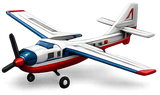
With the wing mounted across the top of the fuselage, the plane's weight hangs below like a pendulum. This creates inherent aerodynamic self-righting tendencies, making high-wing trainers the undisputed #1 recommendation for beginners.
🏞️ Bush Planes & STOL (Short Takeoff/Landing)
Equipped with oversized tundra tires, leading-edge wing slats, and functional slotted flaps. Bush planes can lift off in three feet of grass and touch down at walking speed on rough surfaces.
🏎️ Low-Wing Sport & Warbirds
Low-wing aircraft (like the iconic P-51 Mustang or T-28 Trojan) carry their center of gravity higher, allowing for lightning-fast axial rolls, inverted flight, and high-speed vertical climbs. Recommended once 4-channel high-wing flight is mastered.
🚀 EDF (Electric Ducted Fan) Jets
Instead of a conventional propeller, high-RPM multi-blade fans replicate real turbine thrust and turbine whine. They require high takeoff speeds and careful throttle management, making them suited for intermediate to advanced pilots.
Chapter 4: How Many Channels Do You Need?
In radio control terminology, a channel controls one independent function of the aircraft. Here is how channels translate to flight control surfaces:
| Channel Count | Controlled Functions | Flight Capability | Recommended Skill |
|---|---|---|---|
| 3-Channel | Throttle, Elevator (Pitch), Rudder (Yaw/Turn) | Gentle cruising, slow soaring, climb/descend | Complete Novice / Gentle Soaring |
| 4-Channel (Gold Standard) | Throttle, Elevator, Rudder, + Ailerons (Roll) | Full 3D banking turns, loops, barrel rolls, crosswind crab landings | Primary Entry Point for Dedicated Hobbyists |
| 5-Channel | 4-Channels + Deployable Flaps | Ultra-slow STOL approaches and shorter landing distances | Intermediate / Bush Flying |
| 6+ Channel | All above + Retractable Landing Gear & SAFE modes | Scale military warbirds, clean high-speed jet passes, multi-engine mix | Intermediate to Advanced Pilots |
Looking for a reliable radio controller? Explore our range of computer transmitters at Atlanta Hobby Transmitters & Receivers featuring Spektrum DSMX technology.
Chapter 5: Top Recommended RC Airplanes
Based on flight stability, durability of modern EPO foam, and spare parts availability, our staff recommends the following standout models:
HobbyZone AeroScout S 2 1.1m RTF
Engineered with a rear-facing pusher propeller configuration. If a beginner encounters a rough nose-first landing, the motor and propeller remain completely protected from damage. Equipped with full SAFE flight envelope protection.
- Configuration: Pusher Prop High-Wing
- Wingspan: 1.1 Meters (43.3 in)
- Includes: Transmitter, Smart LiPo & Charger
E-flite Turbo Timber Evolution 1.5m BNF
The quintessential sport bush plane. Features oversized shock-absorbing landing gear, LED navigation lights, slotted flaps, and optional included floats for flying off lakes and snow.
- Configuration: STOL Bush Plane
- Wingspan: 1.5 Meters (59 in)
- Power: 3S or 4S Brushless System
E-flite T-28 Trojan 1.1m BNF Basic
Known throughout the hobby as the most forgiving low-wing airframe ever produced. The wide-stance tricycle landing gear provides flawless ground steering, and the thick airfoil delivers gentle stall characteristics.
- Configuration: Low-Wing Military Trainer
- Wingspan: 1.1 Meters (44 in)
- Features: SAFE Select & AS3X Pre-Installed
📋 First-Flight Field Checklist
Before your first maiden takeoff, make sure you have checked off all essential items: